Meme Coin Trading, What $450K in 30 Days Really Shows
You can order the same kind of articles for your own video to boost it on YouTube and Google. Just message the Telegram bot @sat_sit_bot. It writes articles around your video, embeds the video and publishes them on popular niche websites (no ads). Free trial — 50 articles.
· based on the channel Orangie Web3
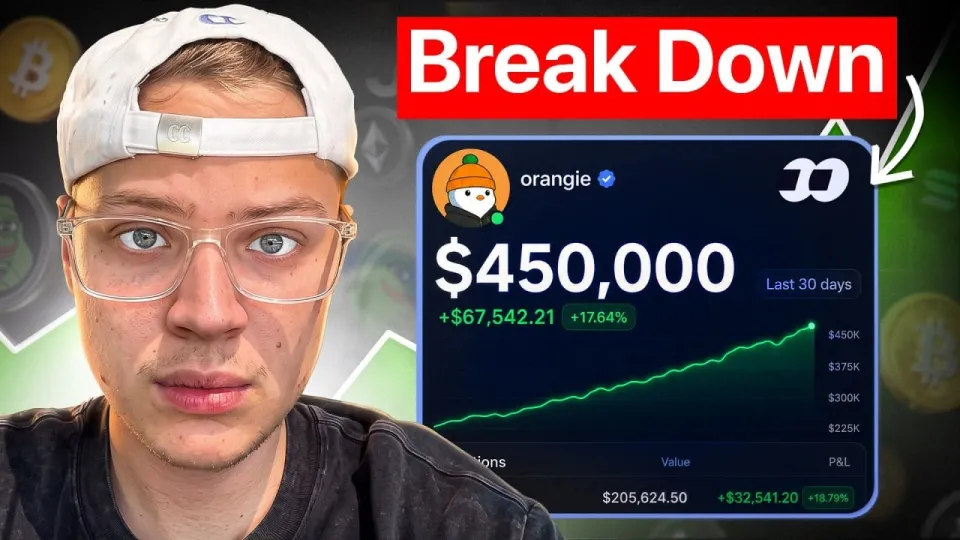
A meme coin is a crypto token with no product, revenue or cash flow behind it — its price is set entirely by attention, liquidity and who is selling to whom. Trading them can produce extreme returns: the Orangie Web3 breakdown of a $450,000 run in 30 days shows how that number is built, and what it costs to chase it. If you want to follow the same workflow, the paid Kaizen group is available via the Kaizen checkout page.
What a meme coin actually is and why it moves
A meme coin is a speculative token whose value rests on narrative and community rather than fundamentals. That single fact explains almost everything about the market: there is no earnings report to anchor a price, so the only inputs are how many people are buying, how much liquidity sits in the pool, and how concentrated the supply is among early wallets.
Three mechanics drive the price action you see on charts:
- Launch curve. Most Solana meme coins start on a launchpad with a bonding curve. Price rises automatically as buyers come in, and the token only reaches a public DEX pool once a market-cap threshold is hit — that event is called graduation.
- Liquidity depth. Thin pools mean a modest buy moves price violently in both directions. A coin with $40,000 of liquidity can double on a few thousand dollars of buying and collapse just as fast on the exit.
- Supply concentration. If the deployer and a handful of bundled wallets hold 30–60% of supply, the chart is not a market — it is a schedule for their exits.
Names like Dogecoin proved the category can hold billions in value over years, but the daily flow of new launches is a different game: short half-lives, fast rotations, and a constant supply of fresh tickers competing for the same attention.
How a $450,000 result in 30 days is actually structured
The headline number is a portfolio outcome, not a per-trade average. A run of that size on a small starting balance almost always comes from a handful of positions that multiplied, surrounded by a long tail of losses and scratches.
The arithmetic matters more than the story. If you start with $2,000 and hit one 50x, you are at $100,000; two or three such hits plus disciplined sizing on the rest gets you into six figures. That is why experienced traders talk about needing one good hit rather than a high win rate — and why the same math works in reverse. A 90% drawdown on a $100 learning account, as one viewer described, is the normal tuition cost of the first month.
What separates a $450,000 month from a $450 month is usually not prediction accuracy but three things: size on the few setups where conviction and liquidity align, speed of exit when the thesis breaks, and the discipline to keep the majority of capital out of any single token.
The Solana launch pipeline, step by step
Solana is the default venue for meme coin trading because launchpads there let anyone mint and seed a token in minutes, with fees measured in cents. Understanding the pipeline is the difference between buying a launch and buying someone else's exit.
- Token creation. A deployer mints supply, often with a large insider allocation and sometimes with bundled buys from many wallets in the same block.
- Bonding curve phase. Buyers on the launchpad push the price up along a fixed curve. Early entries here are cheapest but carry the highest risk of a rug.
- Graduation. Once the market-cap target is reached, liquidity migrates to a DEX pool. This is the moment most retail traders see the coin, because it is when charting tools and call channels pick it up.
- Post-graduation trading. Now the token competes on narrative and volume. Holders either rotate out into the next launch or try to build a community that sustains it.
- Decay or survival. The large majority of graduated tokens bleed out within days. A small minority hold a community long enough to keep trading.
Trading graduated coins, as one experienced commenter noted, is a different skill from sniping launches: you are reading order flow and holder behaviour rather than racing a block. Both can work; mixing them without knowing which game you are playing is where accounts die.
Where the edge actually comes from — and where it doesn't
The honest answer is that most of the edge in meme coins is informational and operational, not analytical. Being in a group where dozens of traders call the same coin within seconds, and where wallets coordinate entries, is a real advantage — and it is also the reason retail buyers often find themselves holding the bag on a chart that looked perfect.
Practical points that decide outcomes:
- Entry speed. On a fresh launch, seconds matter. Manual clicking against bots that snipe in the same block is a losing race; either accept a worse entry after the first pullback or do not play that game.
- Exit planning. Decide the sell levels before buying — typically partial exits at multiples, with a hard rule for the remainder. Traders who only plan entries donate their gains back.
- Wallet hygiene. Use a dedicated trading wallet funded with what you can lose entirely. Never connect a wallet holding long-term assets to a new launch.
- Slippage and fees. High slippage settings on thin pools turn a winning trade into a flat one; priority fees on Solana can eat small positions alive.
- Tax and record keeping. Rapid rotation generates hundreds of taxable events; ignoring this turns a good month into an accounting problem.
Common questions traders ask before their first trade
Viewers of the breakdown repeatedly raise the same practical doubts, and they are worth answering directly. The first is speed: explanations that move fast are useful for experienced traders and overwhelming for beginners, so the fix is to pause and replay rather than to skip the mechanics. The second is losing money early — a near-total loss on a first $100 account is common and is survivable only if the amount was genuinely disposable.
The third is the honesty question: whether the person showing a six-figure month is also trading alongside a network of top traders who share calls and snipe together. The fair assumption is yes — large meme coin results usually come from a group context, not solitary genius, and a viewer trading alone should price that asymmetry in.
Finally, there is the question of what to actually study. Reviewing your own entries and exits — why this coin, why this size, why this exit — teaches more than any signal. A trade journal with screenshots of the chart at entry and exit is the cheapest edge available.
Useful links
The tools referenced around the breakdown, in one place:
- Kaizen group access: https://whop.com/checkout/plan_GTFkEFh0JFpU8?a=orangie
- FOMO trading platform: https://fomo.family/r/orangie
- Discord community: https://discord.gg/memecoins
- Instagram: https://www.instagram.com/orangieyt/
Bottom line on meme coin trading
Meme coin trading is a high-variance game where a small number of winners pay for a large number of losers, and a $450,000 month is a real but rare tail outcome rather than a repeatable baseline. The mechanics are learnable — launch curves, graduation, liquidity depth, supply concentration — but the discipline of sizing, exiting and keeping records is what determines whether you survive long enough to catch a hit. Treat any large result as a case study in structure, not a promise of returns, and only deploy capital you can lose in full. The breakdown comes from the Orangie Web3 channel, and if you want the group workflow behind it, start with the Kaizen group checkout.
Key takeaways
- A trader on the Orangie Web3 channel reports turning a small meme coin account into roughly $450,000 in 30 days, mostly on Solana launches.
- Meme coins are tokens with no cash flow or product; price is driven purely by attention, liquidity and supply distribution.
- Most launches fail: a small share of tokens survive to 'graduate' from a launchpad bonding curve to a public DEX pool.
- Outsized returns come from a few hits, not many trades — the typical pattern is many small losses funded by one large winner.
- Speed and execution matter more than analysis: sniping bots, insider allocations and bundled wallets front-run retail entries.
- The channel's own funnel points to a paid group (Whop), a trading app (FOMO) and a Discord where calls are shared.
Questions & answers
How much capital do you need to start trading meme coins?
You can start with very little, but the amount should be money you can lose entirely — many traders begin with around $100 and expect to lose most of it while learning. Position sizing matters more than the starting balance: keep the majority of capital out of any single token so one rug does not end the experiment.
Is a $450,000 month in meme coins realistic for a beginner?
No. That result is a tail outcome built from a few large multiples on top of many losses, usually with group information and fast execution behind it. A beginner should treat it as a structural case study — how sizing and exits work — rather than an expected return.
What does it mean for a meme coin to graduate?
Graduation is when a token on a launchpad bonding curve reaches its market-cap target and liquidity migrates to a public DEX pool. It makes the coin visible to charting tools and call channels, which is exactly when most retail buyers first encounter it — often after the cheapest entries are gone.
Why do traders in groups seem to win more often?
Because they share calls, coordinate entries and see flow before the public chart does, which is a genuine informational advantage. A solo trader competing on the same launches is effectively on the other side of that edge, so slower entries, smaller size and stricter exit rules are the realistic response.
Source: How I Made $450,000 Trading Memecoins in 30 Days · Markdown version